
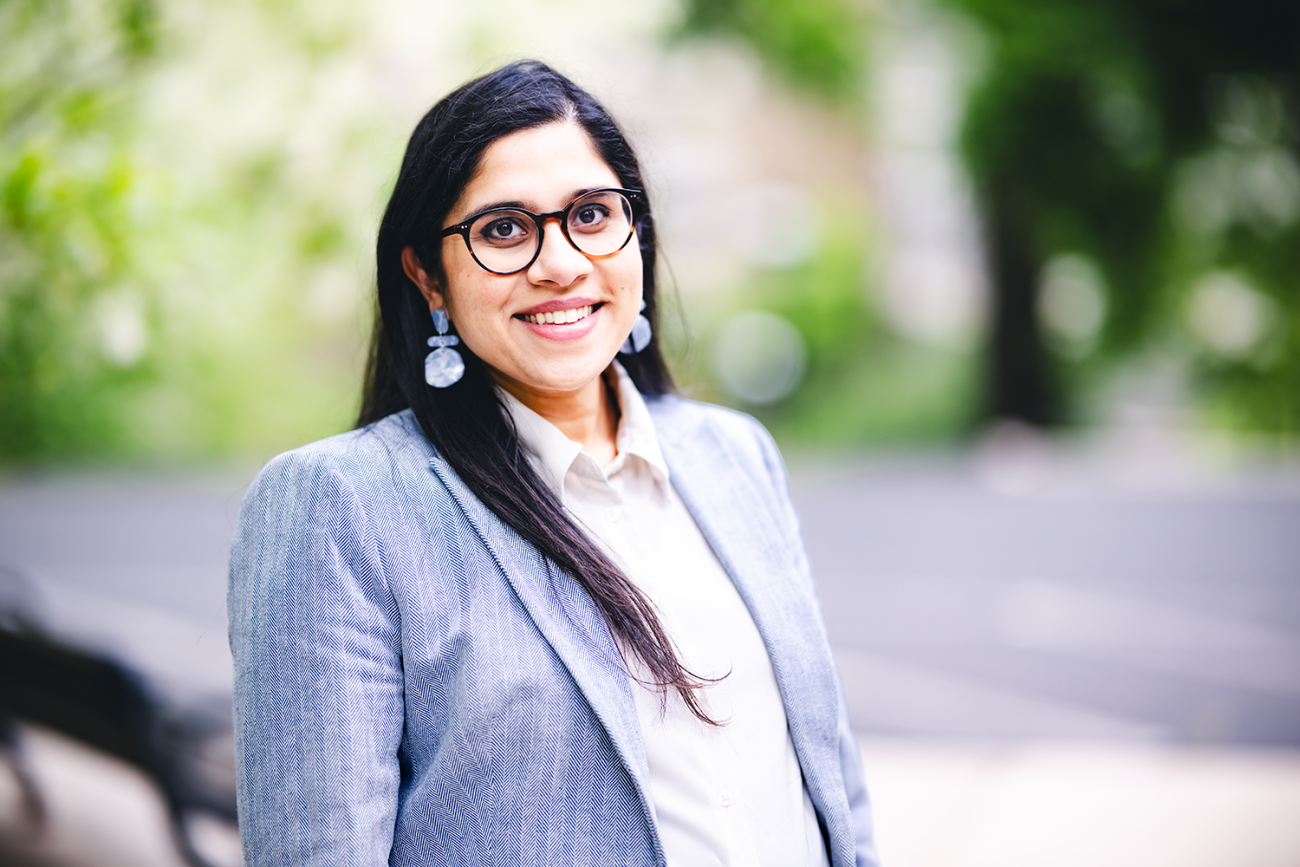
Who Gets to Tell the Story? Madhavi Reddi Studies Identity Through Media
By examining entertainment, journalism, and political communication, Reddi explores how representation influences identity and a sense of belonging.
Growing up in Charlottesville, Virginia, Madhavi Reddi remembers the way Indian Americans were represented in movies and television shows.
Reddi, an assistant professor in the Department of Journalism and Communication, recalls characters like Apu on the animated sitcom The Simpsons, who represented “first-generation depictions” that often reflected offensive cultural stereotypes. Later, conducting research for her doctoral dissertation at the University of North Carolina, she began examining how that has changed for the next generation of Indian Americans like herself, born or predominantly raised in the United States to parents who immigrated as adults.
“How does the performance of identity shift when articulated through a second-generation lens?” she asked. “Looking at identity being articulated through a second gen lens is unique because second gen South Asian Americans are the ones now telling their stories on screen. Apu was predominantly written by white writers and voiced by a white voice actor.”
Considering that question led to research centering questions of identity and belonging. In her dissertation, she introduced the concept of “second-generation media” to describe the proliferation of Indian American or South Asian American stories in mainstream media. Now she’s writing a book about the topic, bringing together research published in several scholarly journals and contributed book chapters.
Studying Representation in the Streaming Era
In the spring 2026 semester, Reddi also taught a senior seminar at Lehigh exploring the topic. In “Second Generation Media: Exploring Asian American Immigrant Media Narratives,” students examined both historical and contemporary representations of Asian Americans in U.S. media and popular culture.
“If you’re familiar with “Never Have I Ever” or “Master of None” or “Indian Matchmaking” or any of the shows that have appeared on streaming services, you’re seeing a lot of stories that highlight, not just the South Asian-American experience, but specifically the second-generation experience,” says Reddi, whose book will explore entertainment media, journalism, and political communication. “Media is a big space where I look at how representation can build a sense of identity, of belonging and community.”
Reddi notes that the emergence of streaming services enabled more diverse stories to be produced. Broadcast television, funded by an ad-based revenue system, chose programming to appeal to the broadest audience. “The widest audience often meant a white audience, and broad appeal often meant the inclusion of stereotypes,” Reddi says. “But then we fast forward to streaming services which are subscription-based revenue models. Streaming services are perhaps less interested in what specifically you're watching, as long as you're paying their subscription fee. So that enables more niche content to be produced, and this creates a platform for more diverse media content.”
How Media Shapes Identity and Belonging
In an article she co-authored in Lateral, the journal of the Cultural Studies Association, Reddi and her colleague, Margaret E. Foster, considered the way the performance of identity has shifted through a second-generation lens. Citing the work of comedians Hasan Minhaj and Aziz Ansari, she explains, “They specifically use humor to construct forms of Desi masculinity that assert their cultural citizenship, their sense of belonging. Cultural citizenship refers to the idea that I could be a legal citizen of the United States, but do my differences, like race or name or religious background, not afford me the ability to be a cultural citizen of America?”
Desi is a term used to refer to an individual of South Asian descent. She notes the comedians have written their own script to articulate their identity. “The way they talk about their first-generation parents….they are establishing their cultural citizenship, asserting their American-ness, by separating themselves from their parents,” Reddi says.
She cites Minhaj’s special “Homecoming King,” in which he talks about how his family was attacked following 9/11. While his father had a more passive response, reminiscent of the Model Minority trope, Minhaj reacted differently. “He says in the show, ‘I was born here. So I actually have the audacity of equality. I’m like ‘I’m in honors gov, I have it right here. Life, liberty, pursuit of happiness. All men are created equal’… I’m equal, I don’t deserve this!’ ”
Identity Beyond Entertainment
In politics, second-generation Indian Americans running for office also assert their South Asian identity to varying degrees. In an article written in 2024 for the Routledge Handbook of Political Campaigning, Reddi examined how former Louisiana Governor Bobby Jindal, a Republican, and Democrat Kamala Harris, then a presidential candidate, communicated their messages through a second-generation lens. “There is a qualitative difference in the ways in which Democrats and Republicans either highlight or don't highlight their Indian heritage, and that is, of course, to appeal to their voter base,” Reddi says. “Indian Americans have historically voted Democrat. Interestingly, we saw some shifts in the 2024 election, and that's another set of research that I'm working on.”
Reddi describes an example of leveraging Indian heritage as political currency in Harris’s earlier 2019 bid for the presidency. In a YouTube video, then-Senator Harris joins Mindy Kaling – an actress, writer and producer in entertainment media – to make dosas, a traditional Indian food. As the pair talk about their shared heritage, Harris notes that Kaling’s dad keeps their spices in Taster’s Choice coffee jars. “Kamala Harris talks about how her mother used to do that too. When I was watching that video, I thought, ‘My Mom does that too,’” Reddi says. “These are things that seem unimportant but actually those are the things that resonate and build the sense of shared identity, a sense of community, and then build a voting network.”
Reddi says the primary finding of her research is that identity is not fixed and is constantly evolving – which echoes decades of research by cultural theorist Stuart Hall and others in the field. “Another key thing that my research seeks to do is to get at the granularity of the South Asian American experience. Much of Eurocentric literature paints national groups and national identities as a monolith,” she says. In fact, India has 28 states and 8 union territories, each with distinctive language, culture, and traditions. She wonders how those distinctive qualities may subtly influence the narrative. “I’m really interested in looking at the ways in which gender, caste, region, and class, how all these different markers of identity manifest consciously or subconsciously in the way second generation South Asian Americans move in the world.”